Workers with Disabilities Committee
Disability is part of every workplace and every union.
The Workers with Disabilities Committee is a disability justice-centred space supporting the Local’s work on disability, accessibility, and inclusion. Disability intersects with every other part of who we are, and this committee exists to make sure those realities are reflected in our union life.
Note: This webpage is a work in progress. The Workers with Disabilities Committee will continue to add and update resources over time, so please check back for updates.
Our work includes:
- Education and awareness about disability and work for Local 5555 members.
- Sharing tools and resources that may help members understand disability rights and accessibility in their workplaces and union spaces.
- Supporting the Local’s accessibility initiatives, including meetings, events, and communications.
- Staying connected with Unifor and broader labour movement campaigns related to disability, accessibility, and social justice.
The committee is made up of Local 5555 members in good standing, including workers with lived experience of disability and allies who are committed to building more accessible union spaces.
The committee does not replace Unit representatives or stewards and does not provide individual representation with the Employer. It works alongside existing Union structures to support disability-related accessibility, education, and awareness for all members.
International Day of Persons with Disabilities
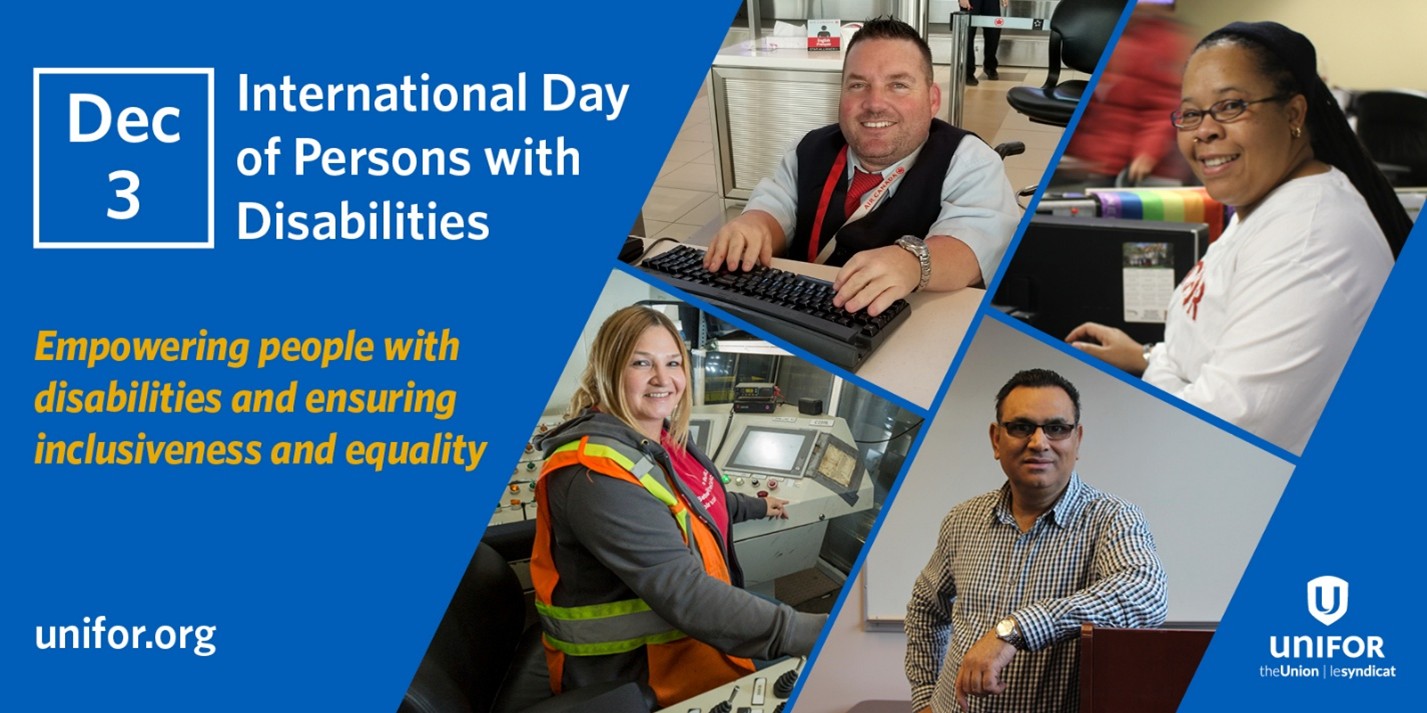
Each year on December 3, we mark the International Day of Persons with Disabilities (IDPD).
Originally proclaimed in 1992 by the United Nations General Assembly, IDPD mobilizes support for critical issues relating to the inclusion of persons with disabilities, promotes awareness-raising about disability issues, and draws attention to the benefits of an inclusive and accessible society for all.
The theme for 2025 is “Fostering disability-inclusive societies for advancing social progress.” It highlights a simple idea: we only move forward when persons with disabilities can participate fully in community life, decent work, and decision-making, including in our unions and workplaces.
To mark IDPD, our committee shares resources that:
- highlight how unions advance disability rights at work;
- explore the connections between disability, poverty, and decent work; and
- offer practical tools for making meetings, events, and union spaces more accessible.
Learn more about International Day of Persons with Disabilities here [https://www.un.org/en/observances/day-of-persons-with-disabilities]
Resources and Videos
Below are some starting points you may find helpful.
How unions advance disability rights at work
A recorded discussion on how unions can remove barriers, bargain for inclusion, and support disability justice in the workplace during the Centre for Research on Work Disability Policy’s 2022 Disability and Work in Canada Conference
Watch the video here [https://www.youtube.com/watch?v=BSivlGBhPts]
Disability Support in the Workplace
If you require assistance with seeking accommodation for your disability in the workplace, you are encouraged to reach out to your Unit Chair or the Local’s Health and Safety Coordinator
Units 1, 3, 4, 5 (McMaster University) Resources
- McMaster University Accessibility Hub
- Accessible Parking and Accommodation Parking Application
- Getting Around McMaster (including accessible building maps and information on accessibility lifts)
- Individual Emergency Response Plan Request Form (pdf download)
- McMaster University Guide and Procedures on Workplace Accommodation
- Workplace Accommodation Policy (PDF download)
Unit 2 (Regional Medical Associated) Resources
Coming soon.
Please contact the Unit 2 Chair or the Local’s Health and Safety Coordinator here
Unit 6 (Royal Canadian Legion Branch No. 163) Resources
Coming soon.
Please contact the Unit 6 Chair or the Local’s Health and Safety Coordinator here
Unifor & Disability
These resources show some of the ways Unifor has, at a national level, taken up disability, accessibility, and AODA compliance in our structures and events. Some of the language reflects when they were created, but the core commitments and practical tools are still useful.
Workers with Disabilities – building our union
Unifor members with disabilities share their experiences at work and in the union, including stigma, accommodation, and bargaining for better collective agreement language.
Context note: This video was produced in 2018 and features Unifor members with disabilities speaking about their own experiences and about unions as a tool for disability rights. It also uses some older disability language, for example, “it’s not about disabilities, it’s about abilities,” and a focus on accommodations being inexpensive and good for productivity. Those ideas come from a real effort to persuade employers, but they can suggest that disabled people are welcome only if we perform at a certain level. Our committee starts from a different place: disability is a normal part of life, and inclusion and accommodation are rights, not rewards we earn by proving our abilities.
Watch Here [https://www.youtube.com/watch?v=IiiT_sGlZ7k]
Unifor Accessibility Plan
Originally published in 2013, Unifor’s accessibility plan outlines how the union meets its obligations under Ontario’s Accessibility for Ontarians with Disabilities Act (AODA). It covers accessible communication, use of assistive devices, support persons, service animals, and how Unifor handles temporary disruptions, training, and feedback processes for people with disabilities.
Access the Unifor Accessibility Plan webpage here [https://www.unifor.org/unifor-accessibility-plan]
Unifor Inclusive Practices Toolkit
Context note: The Toolkit was last updated in 2017 and mentions terms like “disABILITY” and “differently abled,” which some people still use for themselves, and others experience as dated. As a committee, we recognize and respect the language people choose for themselves, and we also start from a disability-centred lens that doesn’t require anyone to rebrand or soften the word “disability.” The practical advice in the toolkit remains useful for planning accessible union events.
This toolkit provides practical guidance for making Unifor events more accessible. It includes checklists and examples for choosing accessible venues, planning room layouts, creating accessible materials (print, digital, large print, audio), registration questions about access needs, booking interpreters and captioning, and building accessible schedules and transportation plans.
Visit the Unifor Inclusive Practices Toolkit Webpage here [https://www.unifor.org/resources/our-resources/inclusive-practices-toolkit]
Download a PDF Copy of the Toolkit [https://www.unifor.org/sites/default/files/documents/Unifor%20Inclusive%20Practives%20Toolkit%20FINAL%20English.pdf]
Download a Large Font PDF Copy of the Toolkit [https://www.unifor.org/sites/default/files/documents/Unifor%20Inclusive%20Practives%20Toolkit%20FINAL%20English%20LARGE%20FONT.pdf]
As you explore these materials, you are invited to notice one change that could make your own meetings, events, or communications more accessible.
If you are interested in joining the Workers with Disabilities Committee, or learning more about its work, please contact wwd@unifor5555.ca.